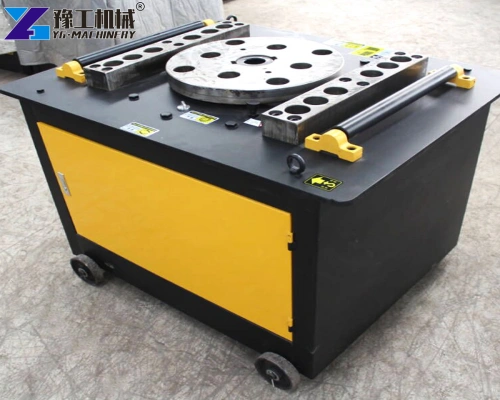
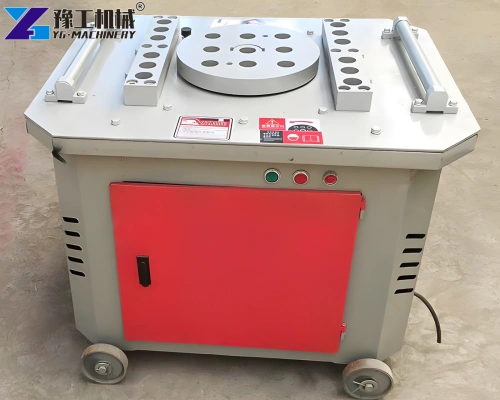
During my years of supporting overseas heavy machinery projects, I frequently receive inquiries from contractors in the Middle East and Southeast Asia: with so many steel processing options on the market, how can buyers make a smart choice without falling into traps? Too many industry peers only praise their own machinery while failing to tell buyers which specific model fits their actual job sites. Today, let’s skip the marketing fluff and look objectively at the fundamental selection logic of a round bar bending machine using official engineering parameters from YG Machinery.
Parameters of the Round Bar Bending Machine
| Model | Technical Parameter | |
| YG-RB40 | Motor Power(kW) | 3 |
| Rebar Diameter(mm) | 6-32 | |
| Round Bar Diameter(mm) | 6-40 | |
| Weight(kg) | 100 | |
| Dimension(mm) | 800*790*780 | |
| YG-RB42 | Motor Power(kW) | 3 |
| Rebar Diameter(mm) | 6-36 | |
| Round Bar Diameter(mm) | 6-42 | |
| Weight(kg) | 240 | |
| Dimension(mm) | 910*755*800 | |
| YG-RB50 | Motor Power(kW) | 4 |
| Rebar Diameter(mm) | 6-40 | |
| Round Bar Diameter(mm) | 6-50 | |
| Weight(kg) | 320 | |
| Dimension(mm) | 995*805*770 | |
Specification Contrast: Side-by-Side Comparison of the YG-RB Series
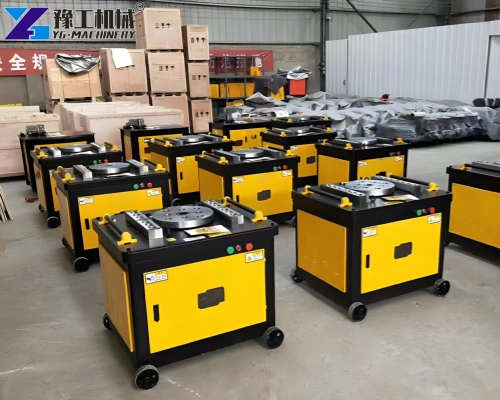
When purchasing a round bar bending machine, buyers often hesitate between different processing capacity brackets. Based on our product matrix at YG Machinery, models like the YG-RB40, YG-RB42, and YG-RB50 offer clear tiering in power and load capability.
For light-to-medium construction, round bar bender units powered by 3kW motors (such as the YG-RB40 and YG-RB42) are highly popular. The YG-RB40 weighs only 100kg with a compact footprint ($800 \times 790 \times 780\text{mm}$), making it ideal for tight job sites requiring frequent relocations. However, when project requirements extend to heavy-duty engineering, upgrading to a 4kW steel round bar bending equipment (such as the YG-RB50) provides a much safer margin. Weighing 320kg, the YG-RB50 delivers significantly higher operational stability. When selecting, you must carefully verify the machine’s rebar bending capacity to prevent structural overload or component wear.
- Selection Tip: If your site demands frequent machine transportation and handles rebar up to 32mm, opt for the lightweight 100kg YG-RB40. For stationary precast yards with continuous cycles, select heavier models (240kg or 320kg) for maximum chassis stability.
Job Site Matching: Which Model Fits Your Project?
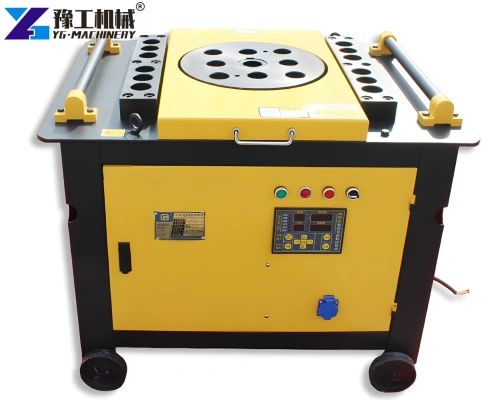
The biggest mistake in machinery procurement is mismatching equipment capacity with project scale. In actual deliveries, I’ve noticed that many overseas clients confuse maximum bending limits between plain round bars and deformed rebars.
According to official rebar bending machine specifications:
- Standard Residential & Civil Construction: The YG-RB40 handles 6–40mm round bars and 6–32mm deformed rebars, making it perfect for house building and small culvert structures.
- Medium Precast Plants & High-Rises: The YG-RB42 extends the rebar capacity limit to 36mm (6–42mm for round bars), satisfying the vast majority of standard structural drawings.
- Heavy Bridges, Dams, & Infrastructure: Facing large-diameter main reinforcement, the YG-RB50 effortlessly bends round bars up to 50mm and high-tensile rebars up to 40mm. Coupled with a 4kW motor, it ensures long-term heavy duty operation without stalling.
- Selection Tip: Due to surface ribs and higher yield strength, a machine’s rebar bending limit is typically 4–10mm smaller than its round bar capacity. Always confirm whether your site uses HRB400 deformed rebar or smooth round bars before finalizing your model.
Field Implementation: How Overseas Clients Cut Costs and Boost Efficiency
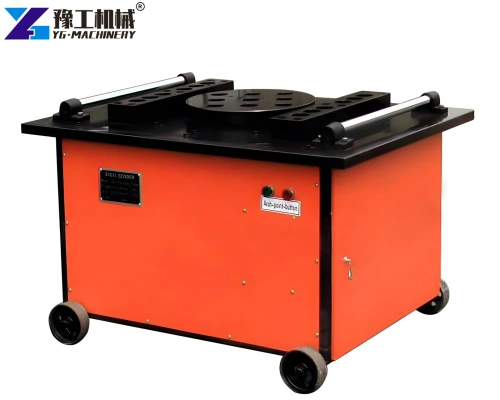
Theoretical parameters mean nothing without practical proof. Let’s look at a real overseas service case. In the spring of 2023, a long-term client Fnanil Sammour from Dubai, UAE, was preparing a large rebar processing facility and initially planned to purchase low-end, budget bending units. After evaluating their local site conditions—characterized by extreme ambient temperatures and high-strength Grade 60 steel—we recommended upgrading their drive system to heavy-duty industrial configurations equipped with reinforced copper tiles and rugged turbine gearboxes, paired with matching cutting machines and spare accessory kits.
This scientific equipment combination not only protected the client from frequent operational jams in the early stages, but also boosted overall cage fabrication efficiency by over 35% during subway foundation construction, extending the trouble-free operation cycle for a full year.
- Selection Tip: Overseas procurement should never focus solely on the FOB price of a single machine. Always calculate total logistics costs, consumable lifespan (such as square blades and copper tiles), and after-sales support responsiveness.
Round Bar Bending Machine FAQ
High-tensile or cryogenic rebars generate higher yield stresses during bending. For these materials, we recommend selecting heavy-duty units like the YG-RB50 with a 4kW motor and a robust 320kg chassis. Additionally, operators should reduce disc speed and use specially heat-treated high-strength tooling pins.
In modern rebar yards, raw materials typically arrive in coils. They must first pass through a straightening and cutting machine, undergo end upsetting or thread rolling according to engineering drawings, and then feed smoothly into the bender for final shaping. Integrated line procurement drastically minimizes manual handling losses.