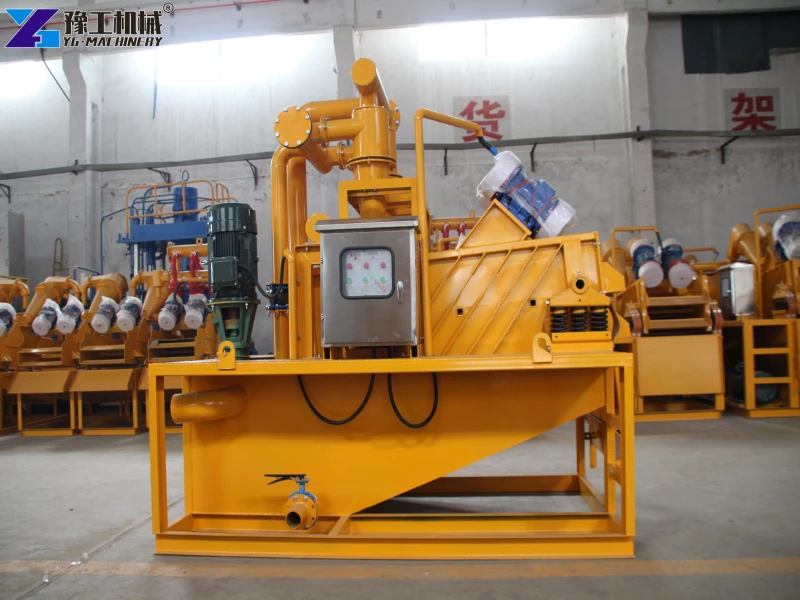
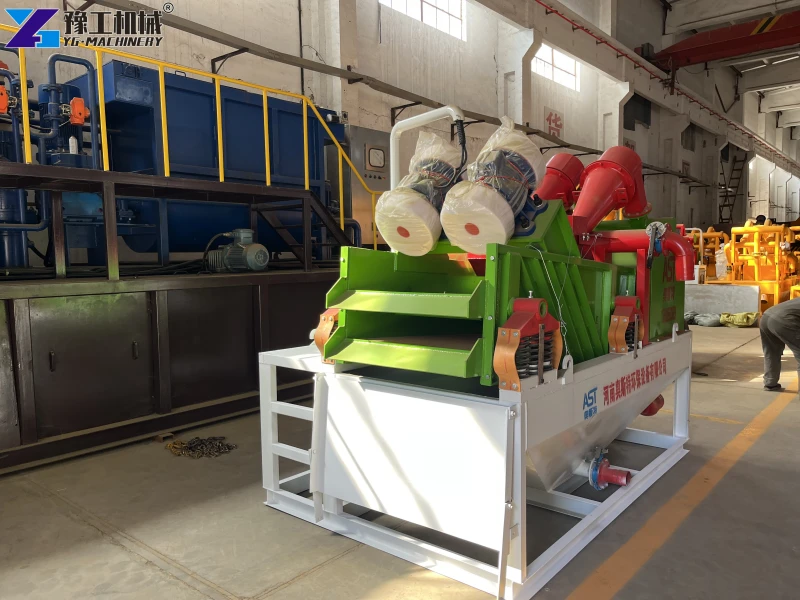
Selecting the right slurry separator is critical for maintaining efficiency on foundation piling, rotary drilling, and dredging jobsites. Making the wrong choice leads to frequent hydrocyclone blockages, screen blinding, and excessive wear on slurry pumps.
Use this conditional decision framework to choose the ideal equipment configuration based on your specific jobsite requirements.
Slurry Separator Parameter
| Model | YG-100A | YG-160B | YG-200B | YG-250A | YG-250B | YG-250C | YG-300C |
| Maximum Slurry Handling Capacity | 100m³/h | 160m³/h | 200m³/h | 250m³/h | 250m³/h | 250m³/h | 300m³/h |
| Total Power | 0.5 kw | 17.2 kw | 24.2 kw | 3 kw | 25 kw | 48 kw | 59.4 kw |
| Vibratory Motor | 0.25kw×2 | 1.1kw×2 | 1.1kw×2 | 1.5kw×2 | 1.5kw×2 | 1.5kw×2 | 2.2kw×2 |
| Total Machine Weight | 550kg | 1950kg | 2050kg | 1350kg | 2300kg | 4000kg | 5500kg |
| Maximum Moisture Content in Discharged Material | 30% | 30% | 30% | 30% | 30% | 30% | 30% |
| Sand Content of Slurry After Purification | <2% | <2% | <2% | <2% | <2% | <2% | <2% |
| Separation Particle Size d50 (μm) | 180 | 180 | 180 | 180 | 180 | 180 | 180 |
| Overall Dimensions (L×W×H) | 2.5*0 .83*2 .1m | 2.7*1 .9*2 .6m | 2.7*1 .9*2 .6m | 3.7*1 .2*2 .4m | 3.3*2 .0*2 .3m | 4.0*2 .3*2 .7m | 4*3*3 .1m |
| Solids Screening Capacity (t/h) | 10-25 | 16-40 | 20-50 | 25-62.5 | 25-62.5 | 25-62.5 | 30-75 |
1. What Is Your Material Profile?
- If your slurry contains high sand ratios with low clay stickiness → Choose a Single-Loop Slurry Separator (A-Type). It utilizes an external feed pump to route coarse solids directly through the double-deck vibrating screen and hydrocyclone, delivering cost-effective solid-liquid separation.
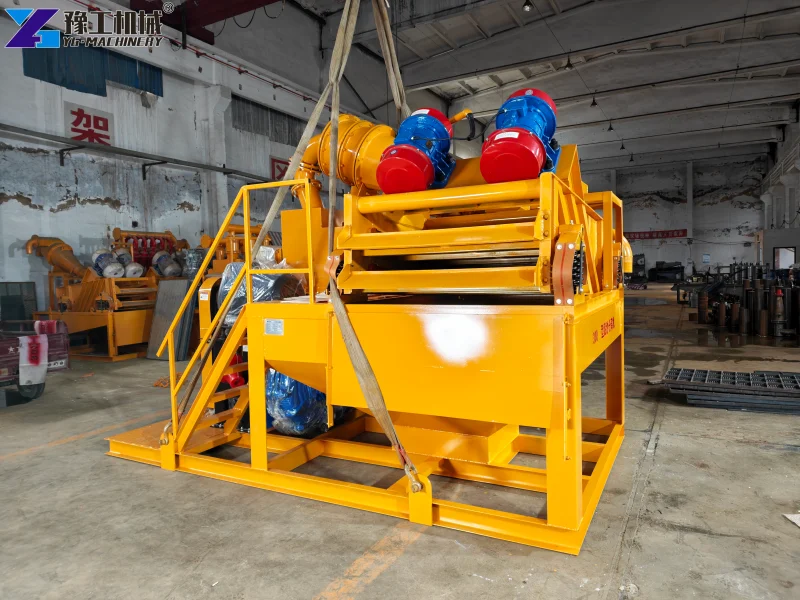
- If your material includes large gravel, high-viscosity mud, or fine sand → Upgrade to an Internal Circulation Slurry Separator (B or C-Type). The integrated high-chromium alloy slurry pump continuously agitates and re-circulates dense slurry to prevent settling and clogging in the tank.
- If you are pumping ultra-fine silt or clay that passes through a 180μm mesh → Pair your desanding plant with a slurry filter press. While a hydrocyclone separates sand down to d₅₀ = 180 μm, a secondary slurry filter press is necessary to squeeze out fine clay particulates and achieve zero-discharge water recycling.
2. What Is Your Required Capacity?
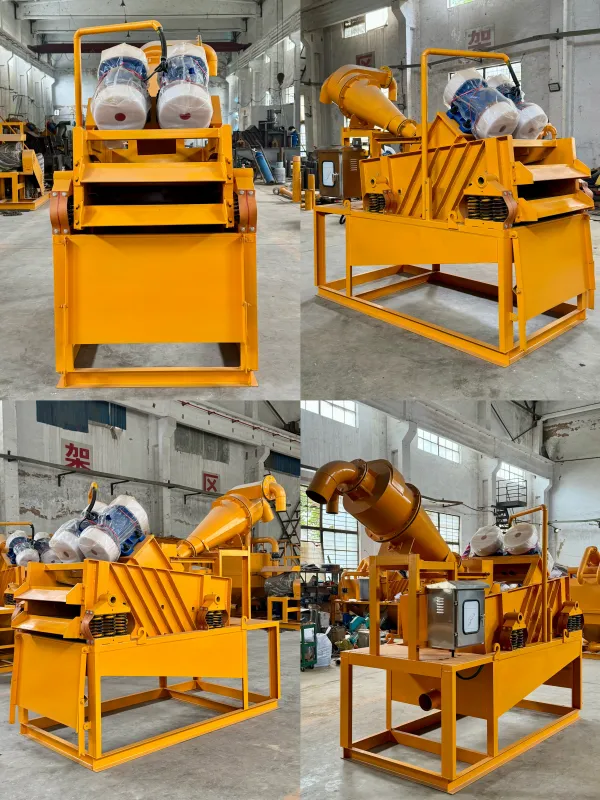
- If your jobsite feed pump operates between 7.5 kW and 15 kW → Select a 100 m³/h to 150 m³/h slurry separator (e.g., YG 100-A or 150-A). These compact units handle smaller piling rigs and utility trenching.
- If your drilling rig demands a flow rate of 200 m³/h to 250 m³/h → Prioritize a 200-B or 250-C model. Equipped with a 22 kW to 45 kW internal pump, these mid-sized units maintain a purified slurry sand content below 2% for deep foundation drilling.
- If your project processes massive volume above 300 m³/h to 400 m³/h → Opt for a 300-C or 400-C high-capacity separation plant. Featuring twin 500mm hydrocyclones and dual 2.2 kW vibrating motors, they deliver up to 100 t/h of dry slag discharge for large-scale bridge piling and microtunneling.
3. What Is Your Working Environment?
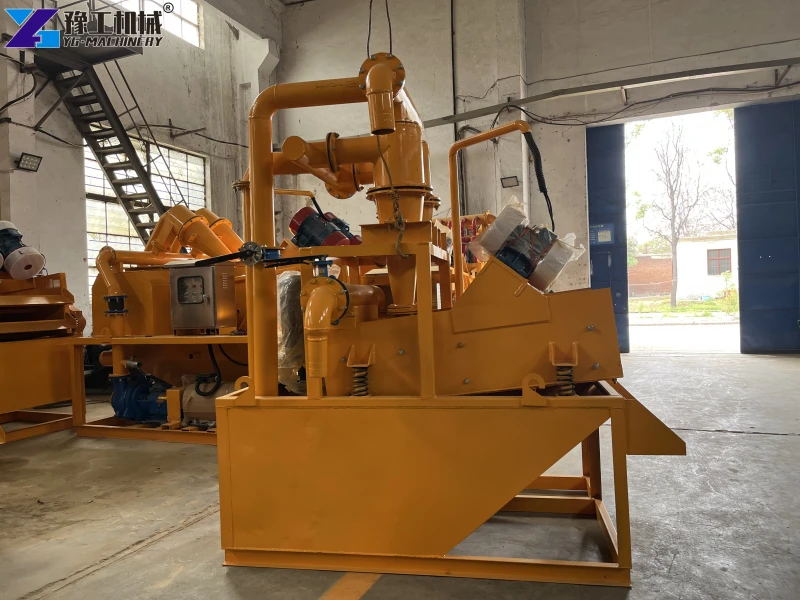
- If you work on restricted urban jobsites or inner-city bridge piers → Select a vertical-pump desanding unit with a compact footprint under 2.5m x 1.5m (such as the YG 100-B).
- If your jobsite is located in remote regions with highly abrasive granite or quartz strata → Prioritize machines equipped with 3cm thick polyurethane hydrocyclone liners and high-chrome alloy slurry pump impellers. Polyurethane lining increases wear resistance against high-speed particulate impact.
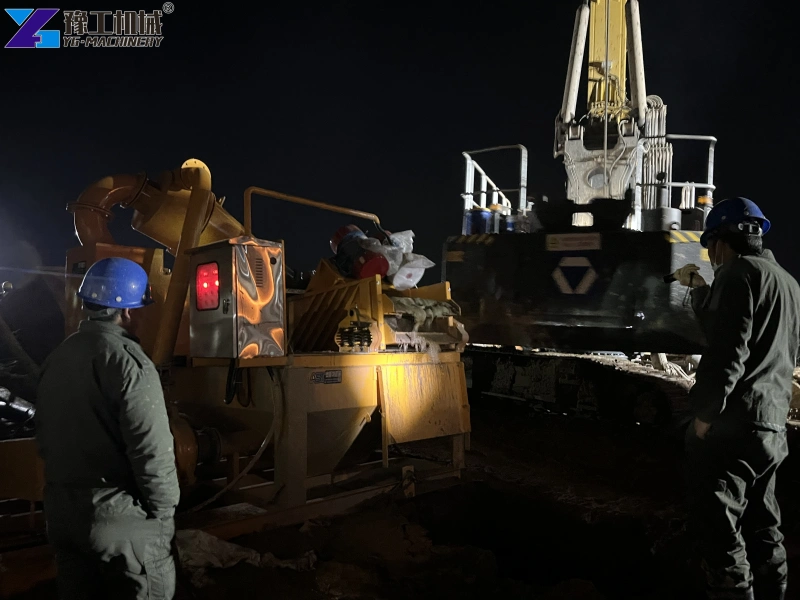
- If you operate near environmentally sensitive waterways or city centers → Choose a fully enclosed, zero-leakage slurry recycling system. Pairing the separator with a dredging robot allows for closed-loop sediment extraction without disturbing surrounding riverbanks or traffic.
4. How Often Will the Machine Move?
- If you move between short-term piling sites every few weeks → Select skid-mounted units under 2,000 kg with top lifting lugs. These units can be loaded onto standard flatbed trucks using a forklift or light crane.
- If your installation is a multi-year project at a fixed site → Install the desanding plant on an elevated steel frame or modular container mud tank to maximize gravity-fed slurry discharge.
5. What Power Source Is Available?
- If your jobsite has a stable 380V/50Hz three-phase power grid → Choose standard electric-driven models ranging from 0.5 kW to 59.4 kW total power consumption.
- If you operate off-grid in remote desert or mountain areas → Pair your separation system with a matching diesel generator set that supplies at least 1.5 times the total motor startup load.
6. What Output or Working Depth Is Required?

- If your borehole depth is under 30 meters → A single-cyclone desanding unit effectively removes coarse cuttings and maintains hole stability.
- If you perform deep shaft drilling or dredging down to 50+ meters → Use a multi-cyclone inner-circulation system. When dredging at extreme depths, combining an underwater dredging robot with a multi-group hydrocyclone separator ensures continuous high-density sediment removal.
7. What Budget Range Is Realistic?
- If your procurement budget is below $6,500 USD → Focus on entry-level single-loop units (e.g., YG 100-A) that rely on your existing feed pump.
- If your budget is $13,000 – $32,500 USD → Choose heavy-duty internal circulation units (160-B to 250-C) featuring built-in horizontal slurry pumps and twin hydrocyclones for all-geology versatility.
- If you require a complete closed-loop treatment plant above $65,000 USD → Invest in a customized multi-stage separation plant integrating a dredging robot, desanding separator, and a heavy-duty slurry filter press.
Slurry Separator Selection Decision Tree
START: Determine Your Project Requirements
│
├── Material: Soft Mud & Fine Silt?
│   ├── YES ──> [dredging robot] ──> Slurry Separator ──> [slurry filter press]
│   └── NO  ──> Proceed to Capacity
│
├── Capacity Needed (m³/h)?
│   ├── < 150 m³/h  ──> Select A-Type or B-Type Single/Dual Cyclone (YG 100-A / 100-B)
│   ├── 150–250 m³/h ──> Select B-Type or C-Type Internal Pump Unit (YG 200-B / 250-C)
│   └── > 300 m³/h  ──> Select High-Capacity C-Type Separation Plant (YG 300-C / 400-C)
│
└── Geology / Material Condition?
    ├── Clean Sand / Low Clay ──> Single-Loop Machine (External Feed Pump)
    └── Large Gravel / Heavy Mud ──> Internal Circulation Machine (High-Chrome Pump)
Get a Custom Slurry Treatment Recommendation
Need a tailor-made mud treatment plan for your specific drill rig or dredging project?
Contact the engineering team at YG Machinery today. Send us your slurry flow rate (m³/h), motor power, and soil analysis to receive a technical proposal and direct factory quote within 12 hours.