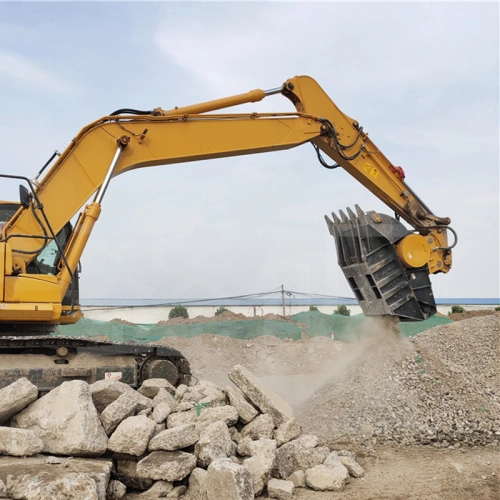
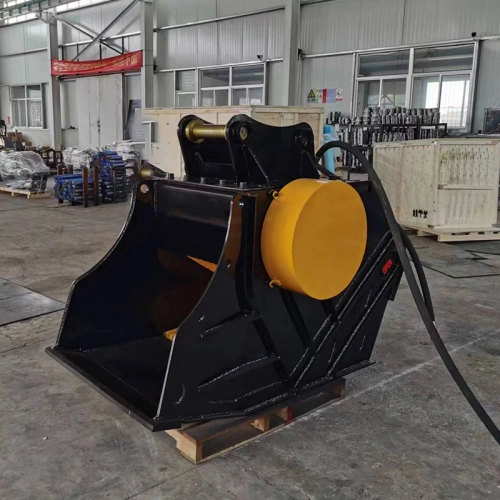
Choosing the wrong bucket crusher causes constant jams and lowers your daily aggregate output. A built-to-last crusher bucket turns site rubble and raw stone into re-usable base material directly on your job site.
Field data shows that running a bucket crusher cuts waste transport costs for contractors by 60%. Crushing material on site removes the need to buy fresh road base gravel. In today’s market, this self-sufficient method shortens project timelines fast.
💡 Field Tip: Do not overload the bucket throat in one scoop! Leave one-third open space so the jaws bite and pull material much faster.
Crusher Bucket Parameter:
| SPECIFICATION | UNIT | YG-1 | YG-2 | YG-3 | YG-4 | YG-5 | YG-6 | YG-7 | YG-8 |
| Carrier Weight | Ton | 8-12 | 14-18 | 120-25 | 25-30 | 30-35 | 35-50 | 50-75 | ≥ 75 |
| Load Capacity | m³ | 0.15 | 0.55 | 0.66 | 0.70 | 0.90 | 1.30 | 1.60 | 2.30 |
| Opening Dimensions | mm | L540 H250 | L610 H510 | L740 H510 | L850 H510 | L910 H540 | L1205 H540 | L1300 H600 | L1450 H700 |
| Output Setting | mm | 15-60 | 15-60 | 15-130 | 15-135 | 15-140 | 15 – 145 | 40-150 | 100-200 |
| Length (A) | mm | 1240 | 1745 | 2000 | 2050 | 2185 | 2185 | 2930 | 3560 |
| Width (B) | mm | 1000 | 1000 | 1150 | 1300 | 1340 | 1620 | 1880 | 2090 |
| Height (C) | mm | 770 | 1100 | 1200 | 1400 | 1390 | 1390 | 170 | 2065 |
| Weight | Ton | 0.75 | 1.6 | 2.3 | 3 | 3.5a | 4.8 | 7.5 | 10.5 |
| Oil Flow | l/min | 90 | 98 | 140 | 160 | 180 | 210 | 320 | 380 |
| Pressure | bar | 200 | 220 | 220 | 220 | 220 | 220 | 250 | 230 |
| Counter | bar | 10 | 10 | 10 | 10 | 10 | 10 | 10 | 10 |
| Max. Production | m³/h | 10 | 23 | 31 | 34 | 42 | 53 | 88 | 120 |
How to Match a Crusher Bucket to Excavator Size and Flow Specs?
Bucket crusher performance relies heavily on your excavator auxiliary oil flow and system pressure.
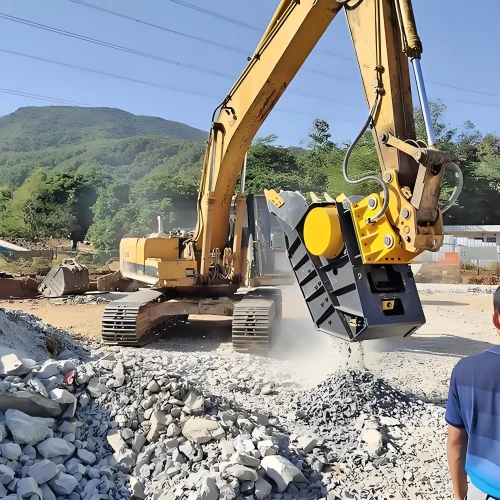
- Medium Excavators (12 – 20 Tons): Match with a mid-size bucket holding 0.6-0.8 m³. They need 120-160 L/min oil flow, perfect for utility teardowns and road work.
- Heavy Excavators (20 – 35 Tons): Select heavy units holding 0.9-1.2 m³. They demand 180-240 L/min oil flow with an adjustable output gap from 15 to 120 mm.
- Severe Mining Excavators (35+ Tons): Mount high-capacity mining units built with high-manganese steel jaw plates that crush tough quarry rocks easily.
On messy demolition sites, crews often use a hydraulic concrete pulverizer first to crush concrete walls and free rebar gridwork. When breaking thick rock ledges, operators switch to a hydraulic breaker. Clearing surface stumps requires an excavator stump shear, while a vibrating ripper cracks hard weathered rock layers.
Where Does a Crusher Bucket Deliver the Highest Job Site Efficiency?
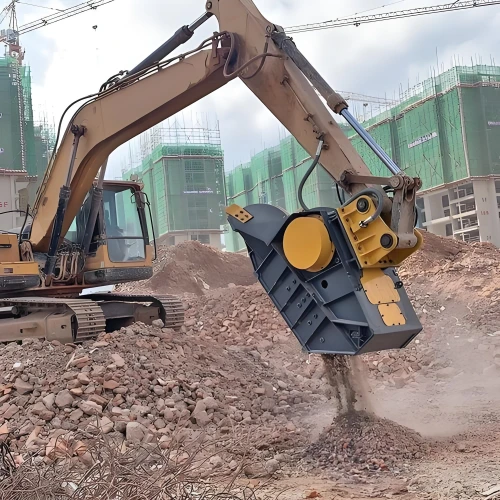
- Urban Demolition & Recycling: Crush concrete debris into 15-80 mm sub-base gravel right on site.
- Road Work & Reconstruction: Process excavated waste rock along the route to backfill road beds instantly.
- Quarry & Pit Clean-ups: Turn mine tailings and secondary waste rock into clean, sellable crushed gravel.
💡 Field Tip: Mount a iron separator magnet below the discharge chute when processing rebar-laden slab to pull steel scrap out automatically.
Field Case: How a Spanish Contractor Cut Transport Costs by 50%?
Mateo, a contractor in Spain, took on a factory site revamp in Madrid. Over 10,000 tons of waste concrete piled up, requiring expensive trucking fees to haul off-site.
We supplied a heavy-duty crusher bucket for excavator use on his 24-ton machine. His crew mounted the attachment using a quick coupler and started work immediately.
The job site gains were real:
- Off-site hauling and dumping fees dropped by over 50%.
- Crushed aggregate filled new foundation beds directly, saving substantial gravel purchasing budget.
- The overall job schedule finished three weeks early, lowering machine rental costs.
💡 Field Tip: Wash mud from underneath the jaw plates with a power washer every evening to stop dried dirt from loading the hydraulic motor next morning.
Frequently Asked Questions (Q&A)
❓ Will rebar-laden concrete jam up the crusher bucket jaws?
Quality crusher bucket designs feature straight jaw angles and reverse rotation functions. As long as rebar pieces fit the output gap, steel slides out smoothly with crushed rock.
❓ How do operators adjust output aggregate size?
Operators can adjust output gap size in minutes by adding or removing shim plates behind the moving jaw plate.
❓ How long do wear-resistant jaw plates last?
We use high-manganese alloy castings. Standard concrete work yields 800-1200 operating hours, and top-to-bottom symmetrical plates flip around to double service life.
💡 Field Tip: When output rock size grows too large, flip the jaw plates upside down to get hundreds of extra working hours.
Ready to Boost Your On-Site Recycling Efficiency?
If you need fast, fuel-efficient, and durable crushing tools, YG Machinery provides direct factory-built equipment for your job. From every crusher bucket model to a full suite of excavator attachments, we support your projects worldwide.
Contact the YG Machinery team today to get your custom model recommendation and quote!