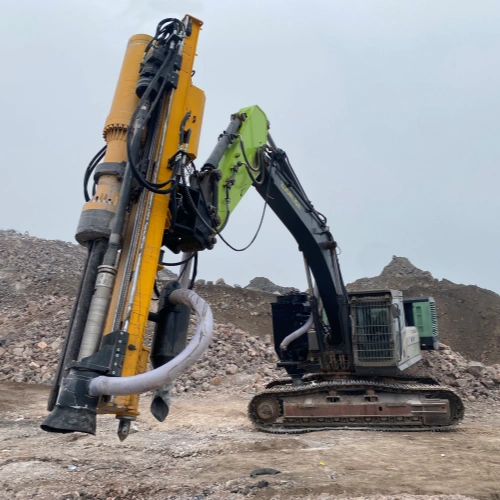
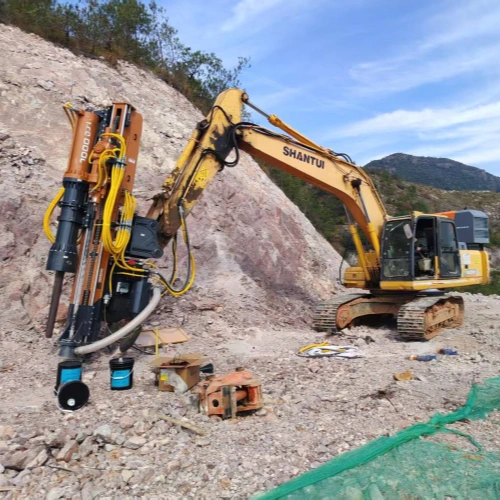
Breaking hard rock above 7 on the Mohs scale often stalls traditional machinery. Standard hammers struggle to penetrate. They cause severe chisel wear and waste gallons of fuel. Meanwhile, explosive blasting involves lengthy permits and strict regulatory oversight. Using a rock splitter for excavator offers a faster, silent excavation method. This equipment runs on your excavator’s hydraulic system. It drills a hole first and then applies thousands of tons of lateral force. The rock splits along its natural grain within seconds.
This guide helps you choose the right non-explosive equipment based on machine tonnage and jobsite conditions.
Where Is a Rock Splitter for Excavator Used?
A rock splitter for excavator handles jobs where explosives are strictly banned. You can mount these attachments on excavators ranging from 24 to 65 tons.
1. Open-Pit Quarries and Secondary Rock Breaking
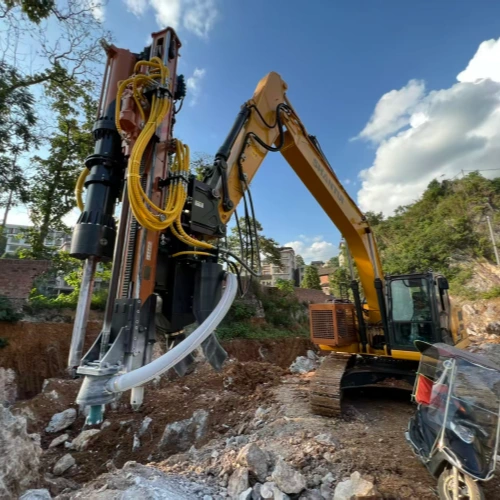
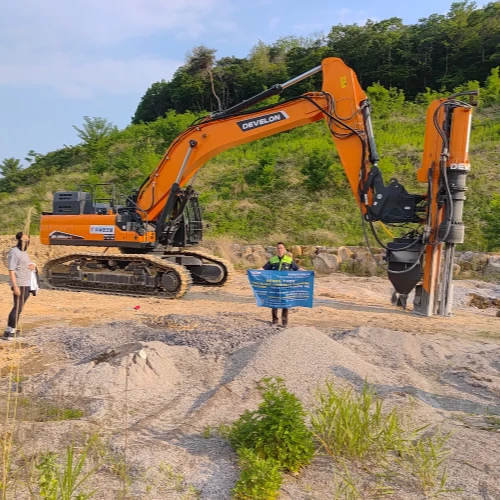
In granite, marble, sandstone, or metal mines, oversized boulders often jam crushers. An excavator rock splitter breaks multi-ton rocks in seconds, making loading and hauling easy.
2. Urban Foundation and Trenching Projects
City construction sites prohibit blasting due to strict noise and vibration rules. Integrated drilling and splitting machines work right against existing building footings without shaking adjacent structures.
3. Tunneling and Slope Stabilization
During road tunnel or underground utility driver runs, this equipment precisely controls rock fracture directions. This prevents over-excavation and reduces the risk of loose rock falls.
💡 Pro Tip: For narrow trenching, pick an attachment with side-swing and multi-angle rotation features. You can adjust your splitting angle without moving the excavator track.
How to Choose the Right Rock Splitter for Your Excavator?
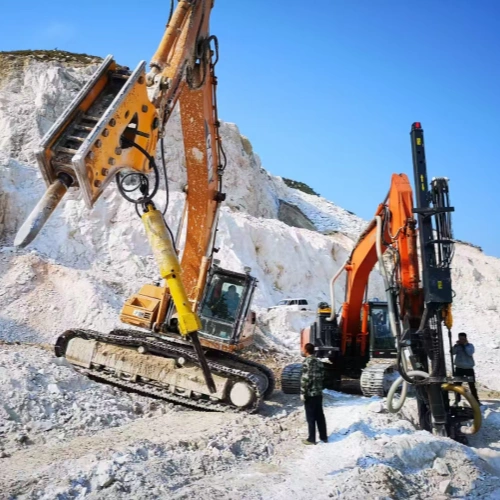
Selecting the correct unit depends on hydraulic flow and excavator operating weight. YG Machinery offers four primary models tailored to different project scales:
- YG-1000 (24–36 Ton Excavators): Uses a 22 kW hydraulic rock drill and 12,000 tons of splitting force with Φ89-127mm hole diameters and 1000mm depth. Total unit weight is 4 tons, yielding up to 411 m³ daily.
- YG-1500 (36–48 Ton Excavators): Features a 30 kW drill and 15,000 tons of force, handling Φ135mm holes up to 1250mm depth. Weighing 5 tons, it yields up to 672 m³ per day.
- YG-2000 (48–65 Ton Excavators): A high-output flagship equipped with a 35 kW drill, 30,000 tons of splitting force, Φ152mm hole size, and 1500mm depth. It delivers up to 1080 m³ daily for heavy mining.
- YG-3000 (48–65 Ton Excavators): An ultra-heavy attachment weighing 8 tons. It combines a 35 kW drill, Φ203mm hole size, 1800mm splitting depth, and 360° rotation for massive rock face excavation.
All units function as All-in-One rigs combining the drill, splitter, feed beam, air compressor, and dust collector, managed effortlessly via a wireless remote control.
How Does It Compare to Traditional Hydraulic Breakers?
Contractors often confuse a rock splitter for excavator with standard hydraulic breakers for excavators. However, their mechanisms are completely different.
A hydraulic rock breaker strikes rock with rapid outer blows. This works fine on shale or soft rock. But against dense granite, the rock absorbs the impact, generating extreme noise, dust, and heat.
Conversely, a rock splitter for excavator uses fluid pressure to drive wedges outward from inside a drilled hole. Rock succumbs easily to tensile stress. The process creates no vibrations, zero flyrock, and minimal dust.
| Feature | Hydraulic Breakers for Excavators | Rock Splitter Attachment |
| Mechanism | External impact (Compressive force) | Internal expansion (Tensile force) |
| Best For | Soft rock, shale, weathered rock | Hard granite, basalt, solid limestone |
| Noise & Vibration | High noise and severe vibration | Low noise, near zero vibration |
| Wear & Tear | High chisel wear, overheated oil | Low maintenance, wedge greasing only |
💡 Pro Tip: If your job site has fractured rock on top, clear it with a breaker first. Switch to the splitter once you hit solid bedrock.
Overseas Customer Success Story
Project Background: Trenching in Madrid, Spain
A Spanish contractor, Mr. Miguel, won a contract for an underground utility trench in Madrid. The ground consisted of solid granite right next to residential blocks. Local authorities banned blasting and loud percussion hammers.
The Solution
Mr. Miguel installed a heavy-duty YG-2000 rock splitter for excavator system on his 45-ton excavator. The attachment featured an onboard 35 kW drill, a multi-stage booster, and a wireless remote control.
Real Results
- Higher Efficiency: Drilling took 3 minutes, and splitting took just 40 seconds per hole. Daily output reached over 1,000 cubic meters.
- Lower Operating Costs: He eliminated a separate air compressor operator and cut fuel consumption by 35%.
- Zero Complaints: The silent, dust-free operation kept neighbors happy and passed environmental inspections smoothly.
💡 Pro Tip: Apply specialized high-pressure grease to the wedge set before every shift. It doubles the life of your splitting counter-wedges.
Frequently Asked Questions (Q&A)
Can I mount this rock splitter for excavator on any brand?
How fast does an integrated unit drill and split hard rock?
What are the main wear parts, and is maintenance hard?
💡 Pro Tip: Always order 2-3 extra wedge sets with your initial purchase. It prevents job delays caused by international shipping times.
Finding the right rock splitter for excavator changes how you tackle hard rock without explosives. It slashes fuel bills, reduces noise, and keeps your jobsite safe and compliant.
If you need help matching equipment specifications (YG-1000, YG-1500, YG-2000, or YG-3000) to your excavator model, contact the technical team at YG Machinery for custom advice and a quick quote.