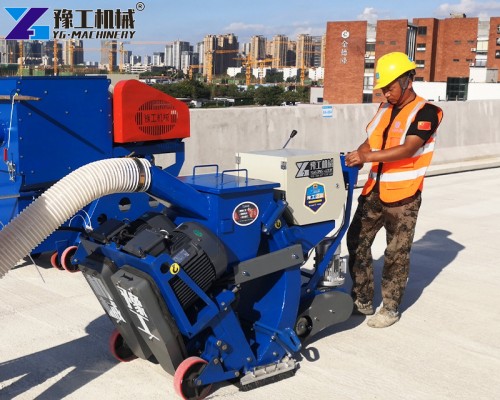
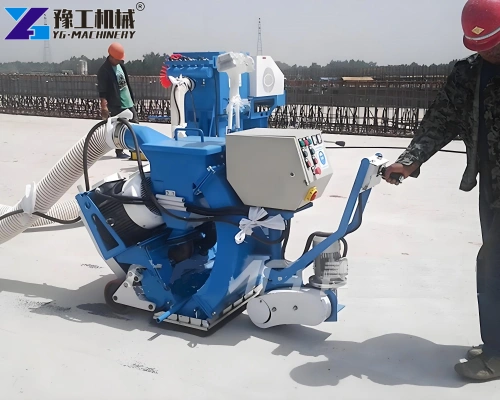
In industrial flooring and pavement rehabilitation, surface preparation directly dictates the adhesion strength of subsequent coatings. Contractors frequently battle with uneven blasting textures, rapid abrasive wear, or constant dust collector clogging. As a direct mechanical manufacturer, YG Machinery delivers this technical analysis of the floor shot blasting machine core mechanics. We break down impeller dynamics, abrasive recovery systems, and job-site configurations to help you secure flawless CSP 3 to CSP 5 surface profiles.
Tip: Blasting efficiency does not depend entirely on motor horsepower. Optimal performance hinges on the adjustment angle of the control cage. Every 5-degree deviation in the cage opening shifts the blast pattern center, cutting striking force across the blasting swath width by 15%.
Floor Shot Blasting Machine Parameters:
| Model | YG-270(Single) | YG550/600(Double) | YG-850(Double) | |
| Shot Blasting Wheel Diameter | 200mm | |||
| Working width | 270 mm | 550/600 mm | 800 mm | |
| Walking speed | 0.5~20 m/min | 0.5~33 m/min | ||
| Concrete surface cleaning efficiency | ≥180 m2/h | ≥400 m2/h | ≥600 m2/h | |
| Steel plate surface cleaning efficiency | 15-25 m2/h | 75-100 m2/h | 100-160 m2/h | |
| Dust connection pipe diameter | 120 mm | 150 mm | ||
| Suggest the diameter of steel balls | 1.2-1.5 mm | 1.5-1.8 mm | ||
| Steel pill consumption | 10 g/m2 | |||
| Supporting a dust collector | Seven-core automatic backflush vacuum cleaner | Eight-core automatic backflush vacuum cleaner | ||
| Shot wheel motor | Power consumption | 11 kW | 11*2 kW | 15*2 kW |
| Input Current | ≤ 15 A | ≤ 22*2 A | ≤ 28*2 A | |
| Walking motor | Power consumption | 0.5 kW | 1.5 kW | |
| Input Current | 1 A | 3 A | ||
| Size (mm) | 1000*300*1100 | 1950*720/775*1400 | 1950*1020*1550 | |
| Weight | 150 kg | 570 kg | 700kg | |
| Power connection requirements | 400V, 50Hz, 100A, CEE socket | |||
Whether operating a highly agile, compact floor shot blaster or an aggressive highway rig, productivity relies on the balance between air volume and media velocity. If your dust collector CFM underperforms, airborne dust accumulation within the rebound chamber dampens the impact trajectory of incoming media, significantly lowering overall production rates.
Tip: When processing asphalt or sticky elastomeric coatings, accelerate your machine travel speed. Ambient friction softens sticky compounds, causing tacky residues to coat the steel media and blind the separator screens.
Demystifying the Blast Wheel Assembly: The Core Engine of High-Velocity Impact
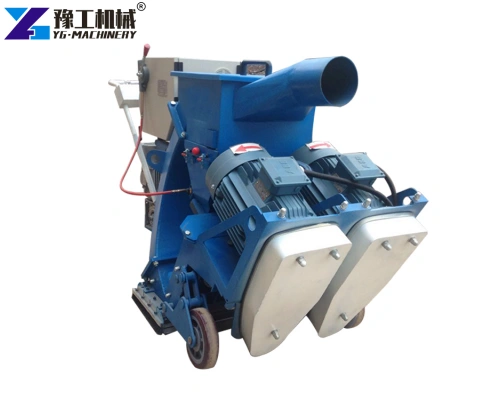
The heart of any premium floor shot blasting machine is its engineering-grade blast wheel assembly. YG incorporates high-performance, direct-drive blast wheels optimized through advanced fluid dynamics for rigorous, non-stop operations.
Generic trading companies reduce production costs by utilizing standard cast-iron blades. Under high-velocity shot projection, these sub-par components deform within 40 operational hours, triggering a sharp decline in kinetic output. Conversely, as a specialized manufacturer, YG outfits its full line of concrete shot blasting machine units with blades investment-cast from high-chromium wear-resistant alloy (Cr12MoV). During continuous site deployment, this premium metallurgy easily withstands extreme rotational speeds up to 2800 RPM, extending the service life of a single blade set to 150–180 hours.
Tip: Inspect the blade wear profile before initiating daily shifts. When blade thickness drops by 1/3 of its original spec, replace the entire blade set in matched pairs. Unbalanced centrifugal forces will rapidly destroy the main spindle bearings.
Abrasive Recycling Mechanics: Optimizing Abrasive Media Consumption
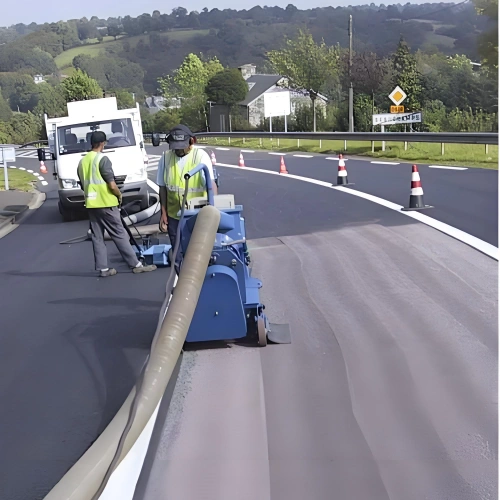
Profitable fleet operations require balancing fast blasting cycles with minimal maintenance overhead. Total abrasive media consumption serves as a key metric distinguishing a premium floor shot blaster from inefficient alternatives.
During execution, steel shots strike the substrate and ricochet back toward the recovery housing. The YG R&D team completely re-engineered the geometric contours of our internal rebound chamber liner. Utilizing 12mm thick heavy-duty manganese steel (Mn12) integrated with a proprietary labyrinth sealing system, this architecture accomplishes two things. It eliminates hazardous media leakage and perfectly channels bouncing media into the cyclone separator. Achieving a 99.5% air-wash separation efficiency of shots from fine dust, this setup slashes media replenishment costs for contractors by 20% per square meter.
This closed-loop separation circuit guarantees that recycled steel beads cycle seamlessly through the machine hundreds of times without premature breakdown.
International Project Insight: High-Spec Industrial Flooring in Malaysia
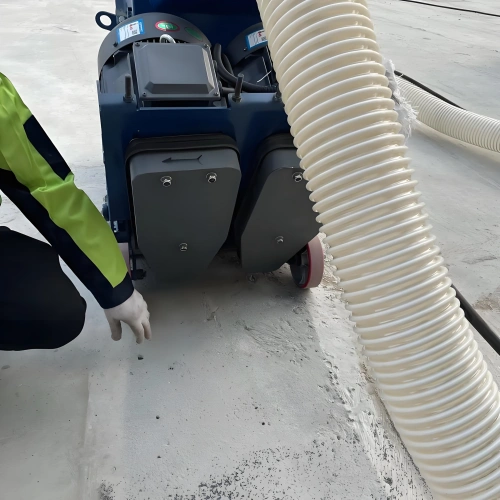
Late last year, a multinational electronics manufacturing plant expansion in Kuala Lumpur, Malaysia, instituted rigorous substrate benchmarks. A 30,000-square-meter concrete slab required uniform blasting to a CSP 3 profile within a strict 10-day window, maintaining zero-dust ambient air quality to protect nearby cleanroom facilities.
The local contractor deployed a fleet of YG industrial-grade floor shot blasting machine units paired with our 750 CFM reverse-pulse dust collectors. YG field technicians instructed operators to lock travel speeds at 6.5 meters per minute. Driven by the consistent cutting force of our high-chromium blast wheel assembly, each machine maintained an average output of 3,500 square meters per shift. The advanced rebound chamber containment system ensured a completely dust-free site environment while keeping media consumption far below industry averages. The team wrapped up surface preparation two days ahead of schedule, facilitating flawless epoxy application.
Tip: In high-humidity tropical climates, purge your dust collector hopper completely at the conclusion of every shift. Dry concrete dust absorbs ambient moisture rapidly, leading to solidified crusts that destroy premium filter cartridges.
Floor Shot Blasting Machine FAQ
This imbalance stems from two primary field conditions. First, check your bottom perimeter rubber seals; uneven wear or a torn section compromises the internal negative pressure zone on that side. Second, your control cage orientation may have slipped. Re-align the control cage scale plate to center the blast stream and replace worn rubber skirts immediately.
The secret lies in media purity. Never introduce contaminated steel media containing sharp slag, construction debris, or aggregates. Extraneous stone particles lack the mass required for blasting and exert extreme abrasive wear on high-chromium blades, cutting component lifespans in half.
Blasting equipment excels at clearing broad surface laitance, contaminants, and thin coatings (CSP 3–5). For deep, heavy mortar beds or thick elastomeric accumulations over 5mm, the best sequence involves using a scarifier to mill away bulk thickness first, followed by a final pass with our blasting equipment to create a clean anchoring profile.