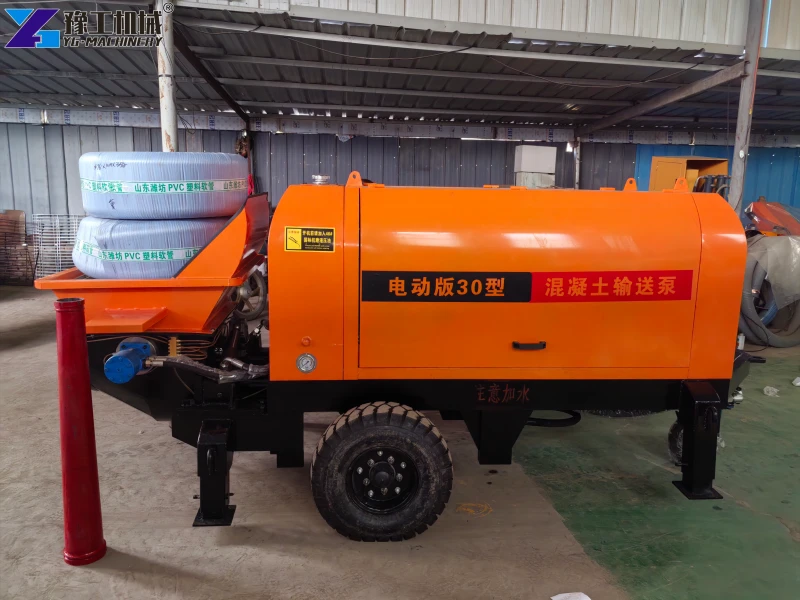
Time is money on a job site. Many contractors pick small portable concrete pumps based on looks alone, and then wonder why their pipes keep clogging. We are skipping the heavy engineering jargon today. Here is the straightforward, real-world advice you need to choose the right machine and keep your pours moving.
💡 On-Site Tip: When pumping fine stone concrete, pipe size and pressure must match. For a vertical pour using an 80mm pipe, keep your system pressure steady at 12 to 15 MPa to get the job done right.
Parameters of Small Portable Concrete Pumps
| Model | YG-20 | YG-30 | YG-40 | YG-50 |
| Motor power | 22KW | 37KW | 45KW | 55kw |
| Maximum outlet pressure | 26mpa | 28mpa | 28mpa | |
| Maximum theoretical throughput | 16-18m³/h | 20-22m³/h | 35m³/h | |
| The maximum particle size of aggregate | ≤20mm | ≤30mm | ≤40mm | |
| Vertical conveying distance | 40m | 80m | 120m | 150m |
| Horizontal conveying distance | 80m | 140m | 2600m | 300m |
| Diameter of conveying pipe | 80mm | φ80 (100) mm | φ100 (80) mm | Φ125/100mm |
| Whole machine weight | 1600kg | 2200kg | 2400kg | 2500kg |
| Dimensions | 3400x1200x1600mm | 3600x1500x1600mm | 4000x1500x1550mm | 4200*1700*1750mm |
The Core Specs That Actually Matter
For a high-quality small portable concrete pumps, focus on the delivery cylinders and the pistons. To keep your concrete moving over long distances or high-ups without stalling, you need a working pressure between 10 and 28 MPa. Look for a cylinder diameter of 160 to 200 mm and a piston stroke of over 1 meter. This ensures a high-volume output even at lower engine speeds.
Open vs. Closed Hydraulic Systems: Which Wins?
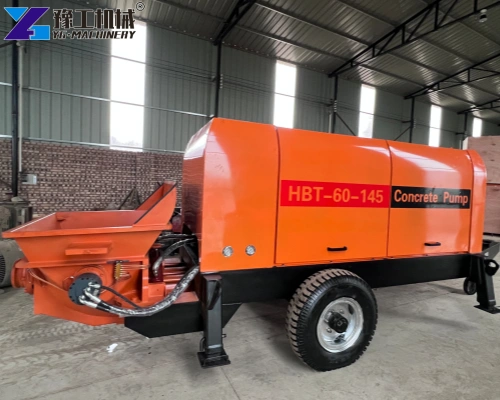
When browsing a mini concrete pump machine, the hydraulic loop setup dictates how long the machine lasts without overheating.
- Open Hydraulic System: It features an independent oil pump and control valves with a larger oil tank. If your job site regularly hits 38°C and you run long shifts, this is the system you want.
- Pressure Safety: Premium pumps feature a built-in regulator. If a clog happens and line pressure spikes, the pump backs off automatically, saving your hoses from bursting.
Tight Alleys and Deep Mud: How to Route Pipes Safely
Real job sites are messy. Before checking out any mini concrete pump for sale, you must calculate your distance and mix thickness.
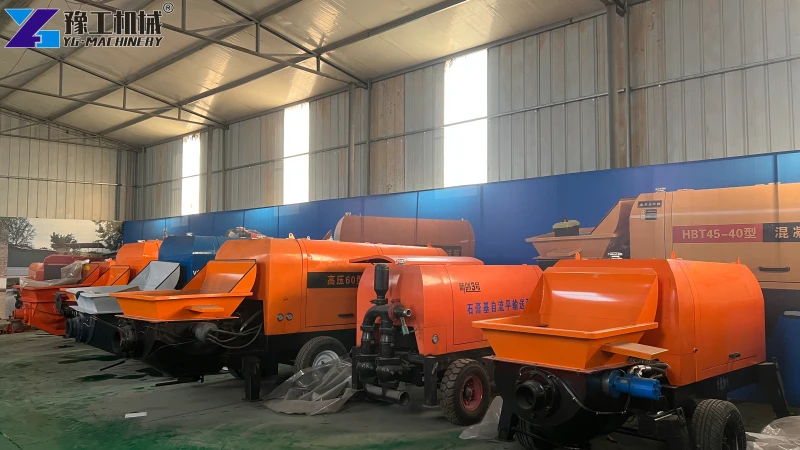
The Big Mistake with Long Pipe Runs
A standard portable pump can push concrete 40 to 120 meters up, or 80 to 300 meters horizontally. But remember this rule: Every 90-degree elbow adds the same friction as 5 meters of straight horizontal pipe. Keep your bends to a minimum and use wide-radius elbows.
- Watch the Rock Size: For an 80mm pipe, keep your stones under 2 cm. For a 100mm pipe, keep them under 3 cm.
- The Muddy Spot-On Thickness: Your concrete should look like thick oatmeal. If it is too dry, it stalls; if it is too watery, it separates and jams.
💡 On-Site Tip: Never let your workers dump water straight into the hopper to thin out a dry mix. It separates the sand from the rock and creates an instant clog right at the S-valve. Use a water-reducing admixture instead.
Going Grid-Free: How a Small Pump Saved a Project in the Mountains
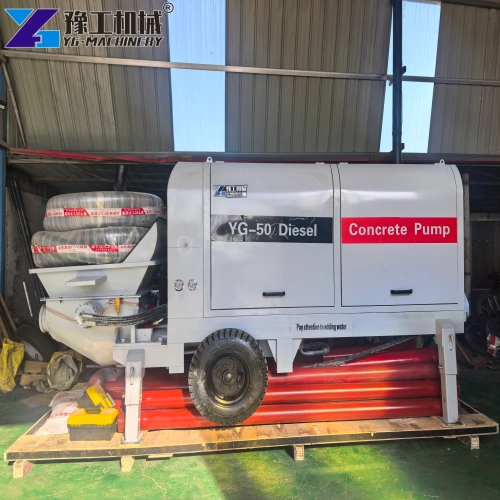
Last year, a drilling contractor in Santo Domingo, Dominican Republic, hit a wall. He needed to pour cement casing for a deep water well in a remote mountain area. There was zero electricity, and the access roads were too narrow even for a wheelbarrow.
He bought a diesel-powered portable mini concrete pump from our team at YG Machinery. Since his local cement was full of clumps, we helped him modify his hopper grid to a 2 cm mesh and installed dual vibratory motors to shake out the big chunks.
Driven by a 37kW diesel engine, the machine worked flawlessly in the wilderness without a grid connection. It pumped fine-stone mix down into a 60-meter deep well smoothly. This quick change cut their operations and maintenance energy costs by 22% and sped up the project by 75%.
Different Job Sites, Different Needs
These small units are highly versatile, but different jobs require different setups:
- Home Basements & Floor Heating: Go with an electric motor drive. It runs quiet, produces zero fumes, and gives you a slow, steady flow for precise leveling.
- Tunnels & Mining Shafts: Space is tight here. You need a chassis narrower than 1.5 meters and a low-slung hopper so underground mini-dumpers can dump their loads directly into the machine.
- Retaining Walls on Slopes: Connect the pump to an external air compressor. The pump feeds the mortar mix at high pressure, and the compressed air shoots it directly onto the hillside.